Help centre
Frequently Asked Questions
Quick answer
We connect Scottish homeowners with MCS-certified installer partners for solar panels, battery storage and air source heat pumps. Finance is available subject to status. Every system is designed around your home and priced at survey with no obligation — no made-up numbers or generic estimates.
Solar + heat pumps
Running solar and a heat pump together
How the two technologies work as one system through a Scottish year.
Partly. Solar panels generate electricity and a heat pump runs on electricity, so they work well together. In summer, solar can cover much of the heat pump's hot-water demand. In winter, when heating demand peaks, solar output is lowest. Over a full year, solar offsets a meaningful share, and a battery helps you use more of it.
Running costs depend on your home's heat loss, insulation, radiator sizes, electricity tariff and how the system is set up. A heat pump uses most electricity in the coldest months. We don't quote generic figures; your survey includes a heat loss calculation, so running costs are estimated for your actual property and tariff.
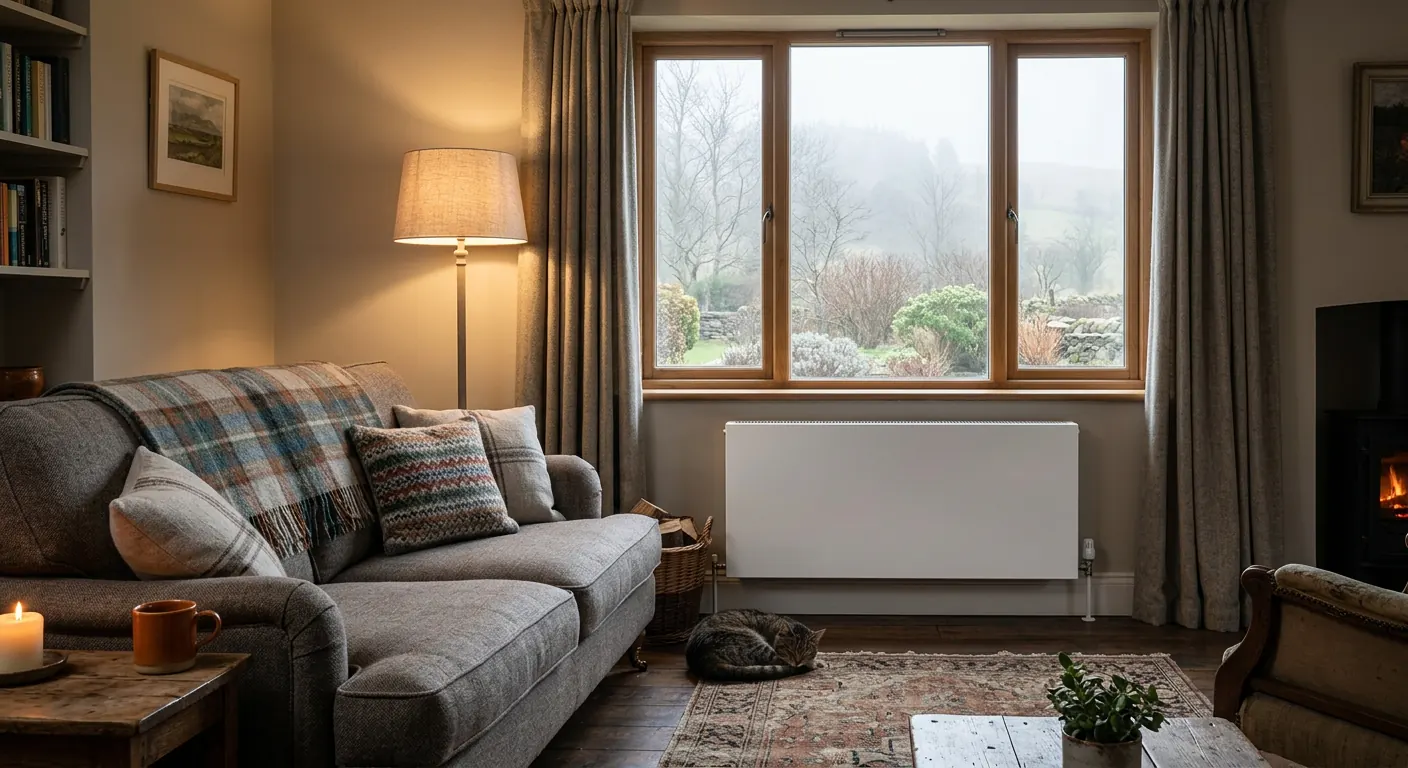
Sometimes, yes. Heat pumps run at lower water temperatures than boilers, so some radiators may need to be larger to keep rooms warm. Your survey includes a room-by-room heat loss assessment, and your installer partner will tell you which radiators, if any, need upgrading before you commit to anything.
Solar and batteries
Solar panels and battery storage
What to expect from solar on a Scottish roof, and when a battery helps.
Not always. Solar works without one, but any electricity you don't use straight away is exported. A battery keeps that surplus for evenings, which matters more if you are out during the day or run a heat pump. Your survey looks at your usage pattern and tells you honestly whether a battery is worth adding.
Yes. Solar panels respond to daylight rather than heat, so they generate on cloudy days too, just less than in bright sun. Output is highest from spring to early autumn and lowest in midwinter. Your survey gives you expected generation for your roof, orientation and location rather than a generic national figure.
In most cases, yes. A battery can often be added to an existing solar system, though it may need a compatible inverter or a separate battery inverter. Your installer partner checks your current equipment during the survey and confirms what is needed, and the price, on your written quote.
Practical
Planning, finance and installation
Permissions, paying for your system and what happens on the day.
Many air source heat pumps on houses in Scotland can be installed under permitted development rights, without a full planning application, as long as certain conditions are met. Rules differ for flats, listed buildings and conservation areas. Your installer partner will advise, but always confirm with your local council planning department before installation.
Interest-free credit of up to £30,000 is available, subject to status and affordability. Terms and conditions apply. If you would like to spread the cost, mention it when you enquire and the options will be explained alongside your written quote.
We connect Scottish homeowners with MCS-certified installer partners. Your partner carries out the survey, designs the system, installs and commissions it, and handles DNO notification (G98/G99). You receive a handover pack when the work is complete, and warranty and guarantee terms are confirmed in writing on your quotation.
It depends on the system and your property. After your enquiry, a no-obligation survey is arranged, followed by a design and written quote. Once you accept, your installer partner agrees a date with you. Your quote sets out the expected programme of work, including any time your home will be without heating or hot water.
Call us on 0141 230 0198 or fill in our contact form. We will arrange a no-obligation survey at your home, then provide a written quote with system design and costs based on your actual property.
Last updated: 28 October 2026 · Reviewed by the Scottish Energy Efficiency team